Key Takeaways (TL;DR)
- Swiggy is one of India’s leading food and grocery delivery platforms.
- The Swiggy business model operates as a three-sided digital marketplace connecting customers, restaurants, and delivery partners through a mobile application.
- Swiggy works simply. Customers select the restaurants and place orders, restaurants receive the order, and delivery partners deliver the items to the destination location.
- The Swiggy revenue model is diverse, with multiple channels including restaurant commissions, delivery fees, in-app advertising, Swiggy Access, Swiggy Super, Swiggy Go, and affiliate earnings.
- In the future, Swiggy can step into Southeast Asia and the Middle East markets and also include AI technology in its operations.
The Swiggy business model works by connecting customers with nearby restaurants through a digital platform. Being one of India’s leading food delivery platforms, understanding its business model helps entrepreneurs to know how a digital marketplace works and generate revenue.
This article will give you detailed insights about how Swiggy works, its revenue strategies, business model, and what it is planning in the coming years, which will help you plan your similar business effectively.
What is Swiggy?
Swiggy is one of India’s leading online food and grocery delivery marketplaces. It was launched in August 2014 by Sriharsha Majety, Nandan Reddy, and Rahul Jaimini.
Earlier in 2013, Sriharsh Majety and Nandan Reddy launched the company as Bundl Technologies as a courier delivery and shipping website in India.
But later, both founders witnessed a gap in the Indian food delivery market, which inspired them to start Swiggy by teaming up with Rahul Jaimini, a former Myntra employee in Bengaluru. Today, it has become a household name in India.
The key differentiator that has helped Swiggy become successful is that, unlike its other competitors, like EatSure and MagicPin, it is operating and managing its own delivery fleet.
A Look into Swiggy’s Growth Journey
During its initial phase in 2014, Swiggy started its journey with 6 delivery boys and 25 restaurant partners. Also, it received only 35 orders in the first month. But within one year, as it gained more popularity, it expanded its operations in the Tier I cities of India. And today, it is operating in more than 500 Indian cities with a network of over 150,000 restaurant partners and 260,000+ delivery providers.
Company Overview
Founded on: 26 December, 2013
Founders: Sriharsha Majety, Nandan Reddy, Rahul Jaimini
Key People: Sriharsha Majety (CEO), Rohit Kapoor (CEO – Food), Rahul Bothra (CFO)
Headquarters: Bengaluru, Karnataka, India
Industry: Food delivery and Quick Commerce
Total Revenue (2025): Around US$2.22 billion
Total Funding: $5.1 billion in 20 rounds
Over these many years, Swiggy has grown from a mere food delivery platform to a hyperlocal super app by bringing other services like grocery delivery, logistics, and dine out in one app. Let’s take a look at the major milestones achieved by Swiggy over the years.
Success Timeline of Swiggy
2013
- Launched as a courier delivery company, ‘Bundl Technologies’ in Bengaluru by Sriharsha Majety and Nandan Reddy.
2014
- Launched as an online food delivery platform by Sriharsha Majety, Nandan Reddy, and Rahul Jaimini in Bengaluru.
2015
- Received its first $2 million funding from Accel and SAIF Partners.
2017
- Launched its cloud kitchen ‘The Bowl Company’ in Bengaluru.
- Also started ready-to-occupy kitchens, ‘Swiggy Access’ for its restaurant partners.
2019
- Expanded its food delivery operations in 500 Indian cities.
2020
- Launched Swiggy Instamart, which promised to deliver groceries to customers’ doorsteps within 45 minutes.
- Also started package delivery service for instant pickup and drop off of parcel goods.
2022
- Created history by launching the first end-to-end drone delivery trials in India by partnering with ANRA Technologies.
2023
- Partnered with Gogoro (a Taiwanese battery-swapping refueling platform for 2-wheelers) to provide smart scooters to its delivery partners
2024
- Partnered with IRCTC (Indian Railways) to offer food delivery services in railway stations.
Swiggy Business Model Canvas
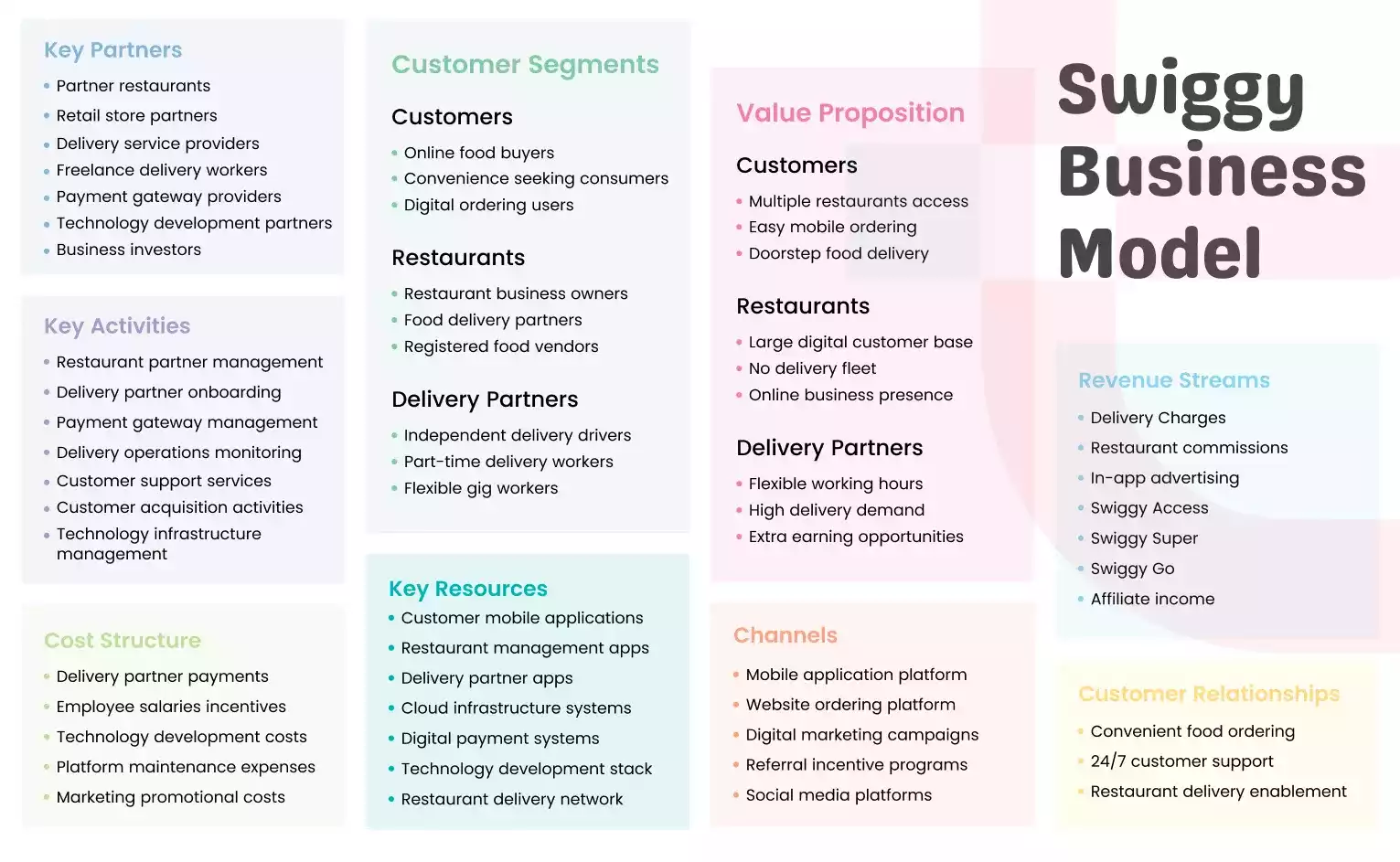
The Swiggy business model operates as a hyperlocal three-sided digital marketplace that connects customers with restaurants and delivery partners through a single app. Let’s have a detailed glimpse of the model’s important aspects.
Value Proposition
Swiggy creates value for all its customers.
For Customers:
- Provides access to several restaurants in a single app
- Can easily order meals through a few taps on mobile phones.
- Do not have to physically visit restaurants.
For Restaurants:
- Get access to a large customer base digitally without investing in a web platform.
- Do not have to handle the delivery fleet
For Delivery Partners:
- Flexible working hours
- Large delivery orders allows to earn more
Key Partners
There are many partners with whom Swiggy has collaborated successfully, and some of its key partners are:
- Restaurants and retail shops that consider registering themselves with the platform.
- Delivery providers provide their valuable delivery service to foodies on demand.
- Part-time or full-time freelancers who provide their services to earn some extra pennies.
- Reliable payment processors to enable secure transactions.
- Technology provider to build web and mobile applications.
- Investors for technology enhancements and operational expansions.
Key Activities
The platform conducts several key activities to ensure smooth operations.
- Develop strong relationships with retail stores and restaurants.
- Hire full-time and part-time delivery providers.
- Provide easy and quick payment gateways to provide an excellent experience to customers.
- Manage and monitor the delivery process to ensure excellent delivery service to foodies.
- Develop and manage tech infrastructure and keep it updated.
- Provide a customer support team to solve user queries and disputes instantly.
- Manage customers in order to acquire them.
Cost Structure
There are numerous expenditures that Swiggy has to cover during its business operations.
- Amount to pay workers and delivery partners.
- Incentives and other advantages are provided to employees and partners.
- The expense of crafting tech solutions.
- Platform maintenance and marketing costs.
Customer Segments
The platform involves three user groups, including customers, restaurants, and delivery partners.
Customers
- Customers who want to enjoy their favorite food at their doorsteps.
- Eaters who avoid going physically to restaurants and retail stores.
- Food lovers who love to make a purchase through digital tools.
Restaurants
- Provide an on-demand food delivery service to earn more for their business.
- Restaurants provide their service by registering their delivery business on the platform.
Delivery Providers
- Independent drivers who want to earn more through the digital platform.
- Drivers who want to work according to their convenience.
Channels
Numerous channels are included in the Swiggy business model, which help them reach a larger user base easily. reach a huge customer base.
- Marketing campaigns
- Web and mobile apps
- Referral programs
- Social media platforms
Customer Relationships
The platform focuses on building strong customer relationships in different ways.
- Allowing customers to order their favorite meals from the comfort of their space.
- Providing all-time customer support to resolve queries instantly.
- Restaurants can offer online delivery services without having their own digital storefront.
Key Resources
Swiggy requires different resources to ensure smooth and efficient food delivery operations.
- Dedicated applications for restaurants, customers, and delivery partners.
- Cloud infrastructure to scale easily whenever needed.
- Payment processor systems for digital payments.
- The technology stack is used to provide on-demand service to customers.
- A strong network of restaurants and delivery partners to offer delivery services.
Launch a Food Delivery App Similar to Swiggy, Partnering with Elluminati for a Market-Ready Solution
How does Swiggy Work?
Swiggy follows a simple workflow approach with impressive food delivery app features. Customers place orders by selecting their desired restaurants and dishes, restaurants receive orders, and delivery partners deliver the items to customers’ doorsteps. Here is the complete breakdown of how Swiggy works.
Customer Places an Order
- The customer logs into the app and enters the location. The app’s smart matching algorithm analyzes the address details and shows the nearby restaurants based on ratings and delivery time.
- The customer chooses the restaurant and adds items they want to order to the cart.
- The app gives complete order details at the time of checkout, which includes the total order price along with delivery fees and applicable service charges. It also shows order customization options and applicable promo codes.
- Customers can customize the order with extra items.
- At last, they confirm and checkout by paying with their preferred method, which includes cards, digital wallet, UPI, or cash-on-delivery.
- Customers can rate their experience and share feedback once they receive the order.
Restaurant Receives Order
- The moment the customer places the order, the request is sent to the restaurant on their Swiggy partner dashboard.
- A restaurant can either accept or reject the request based on its availability.
- After confirmation, the restaurant enters the preparation time on their merchant dashboard, which is immediately notified to the customer on their live tracking screen.
- The restaurant then starts preparing the order.
- They receive their payment after the order reaches the customer. Swiggy deducts its commission from the total order value and makes the payment.
Swiggy Assigns a Delivery Partner
- Once the restaurant has prepared the order, Swiggy’s smart algorithm finds the nearest available delivery partner based on the location.
- The delivery partner receives the notification with details like the restaurant and the customer location on their app. They have the authority to accept or reject the request.
- After accepting, the delivery partner picks up the order from the restaurant and delivers it to the customer’s location.
- App’s built-in GPS system helps delivery partners optimize routes and reach the locations quickly and efficiently.
- The delivery partner receives payment after the platform deducts its commission.
Understanding the Swiggy Revenue Model
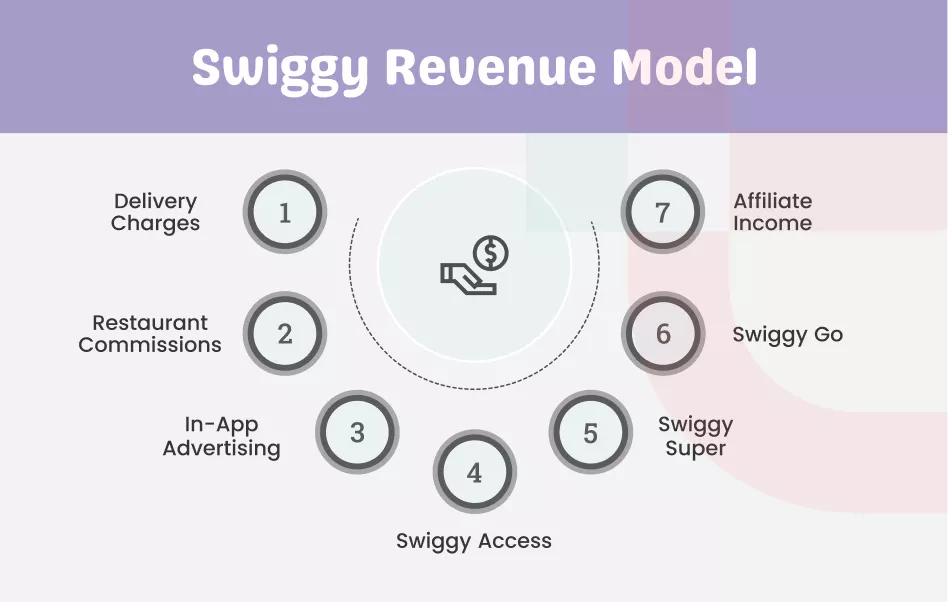
Swiggy generates revenue from multiple streams including restaurant commissions, delivery fees, and more. Let’s have a detailed glimpse of how Swiggy makes money.
Delivery Charges
One revenue source of Swiggy is the delivery charge from the customers on all the orders. The charge differs based on the distance, surge hours, and locations.
Restaurant Commission
The app charges a 15%-30% commission fee to restaurant partners on all the orders they receive through the Swiggy platform. The percentage can vary depending on factors like location and whether the restaurant uses Swiggy’s delivery fleet.
In-App Advertising
Swiggy gives space to restaurants to advertise three brands, food, and offers. Also, there are two types of advertising that Swiggy is offering.
- One is a paid banner advertisement where restaurants can display ads on the app and get greater visibility in that region.
- Another is that Swiggy allows restaurants to be listed as the top available restaurants as a paid advertising service.
Swiggy Access
Swiggy helps its restaurant partners to find a dark kitchen to extend its services and reach closer to the customers for swift services, and it charges them access fees.
Swiggy Super
Swiggy gives its users some leverage with premium accounts, like zero delivery charge when orders are above $99, no surge charges, etc.
Swiggy Go
Allowing users to pick and send parcels from one place to another in exchange for the delivery fees
Affiliate Income
Swiggy partners with financial institutions like Citibank, HSBC, and ICICI Bank, earning benefits from it and allowing customers to earn rewards on their credit cards.
Swiggy’s Future Outlook
In the future, Swiggy aims to maintain its leading position in the market with the help of technology enhancements and also cover India’s 85%-90% untapped areas.
Today’s world is AI-powered. The use of AI in food delivery apps is growing rapidly as it is helping businesses enhance customer experiences. And Swiggy is also making strategies to enhance the operational efficiency of its restaurant and delivery provider network with the help of generative AI solutions.
Besides, it is also actively using the smart Gen AI.. It uses AI-powered data analytics tools to make tailored recommendations to customers. Further, the company is planning to use smart technology for implementing the Dineout conversational bot, which will guide users to preferred restaurants while dining out.
These technological enhancements highlight how Swiggy is planning to transition into a fully technology platform rather than being a mere transactional application.
How Elluminati Can Help You Build an App Like Swiggy?
The Swiggy business model showcases how a technology-driven platform can connect customers, restaurants, and delivery partners in a single ecosystem. This understanding allows entrepreneurs to learn how they can manage on-demand delivery operations and generate profitable revenue.
If you are considering building an app similar to Swiggy, then Elluminati becomes your experienced technology partner. We offer a ready-to-launch Swiggy clone that allows you to enter the competitive food delivery market quickly with a pre-tested approach. With features like contactless delivery support, automated order management, and multilingual support, our solution allows you to launch and scale operations easily.
FAQs
The Swiggy business model operates on a hyperlocal three-sided marketplace that connects customers with nearby available restaurants through a mobile application.
The Swiggy revenue model generates income from multiple sources, including:
- Delivery charges
- Store commissions
- In-app advertising
- Swiggy Access
- Swiggy Super
- Swiggy Go
- Affiliate Earnings
Swiggy charges 15%-30% commission to restaurants. However, the percentage may vary depending on factors like the partnership contract.